- The most recent issue to be published was 53(2)
- For further information, please see Publishing/Despatch Schedule
- Database last updated on Thu, 13 Aug 2026 15:21:38 +0100
Open Access to C&KS: From Volume 51(1) (April 2024) all individual papers in C&KS will be Open Access, although some additional content
(e.g. supplements) might still require a login. Open Access means that you will not need to log in to download a paper. Open Access is indicated by the open padlock icon
next to each listing. Issues of C&KS published before 2024
(i.e. volume 50 and earlier) continue to require a login, which is free. BCRA members may apply for a free online id, and all visitors to these pages are offered
the option of a monthly free login when they try to download any protected content.
Contents of Cave & Karst Science 53(2)
This page may take a few seconds
to load. Please wait ...
- Cave and Karst Science (iv + 44pp)
(PDF 9.9MB)
  Individual articles may be available below Individual articles may be available below
- LOWE, David and John GUNN (eds.). (2026). Cave and Karst Science
53(2).
Buxton: British Cave Research Association.
ISSN 1356-191X. iv + 44pp, A4, with photos, maps and diagrams.
This issue has a cover date of 2026 (August) and was published in August 2026.
- The Transactions of the British Cave Research Association.
The PDF files comprising this issue are at a high resolution and have been assembled using an RGB colour space. The single file containing the entire issue (see above) is at a lower quality, suitable for screen-reading.
- Front Cover Photo (page i)
(PDF 4.5MB)
- by Chris HOWES.
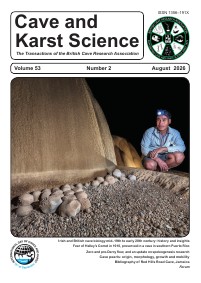
Unusual cave pearls in the Xe Bang Fai River Cave, Hin Nam No National Park, Laos. See commentary on the contents page. (Photo: Chris Howes).
-
- Notes for contributors (page ii)
(PDF 830KB)

-
- Contents (p49)
(PDF 1.1MB)
-
- Editorial (p50)
(PDF 2.9MB)
- by John GUNN and David LOWE.
-
- Cave pearls: origin, morphology, growth and mobility (pp51-60)
(PDF 14.2MB)
- by Garry K SMITH.
Among speleothems, cave pearls are commonly overlooked and hence have generated less research interest than more-obvious cave deposits such as stalactites, stalagmites, and curtains/shawls.Yet, when considered in detail, aspects of the creation and morphology of cave pearls, as secondary unattached mineral deposits, are more complex than they appear at first glance. Many variables influence their growth, structure and appearance; these factors deserve deeper investigation to help provide a better understanding of their creation parameters. This article summarizes published knowledge about – and previous discussions of – cave pearls and includes details of the author's related observations.
The parameters that create cave pearls with smooth or coralline (dendritic) morphology are discussed along with what prevents them from adhering to the cave floor substrate. Their morphology is typically related to their location beneath a drip point or whether they are partly or fully immersed in a pool of water. Whereas their continued detachment relies on being repeatedly moved or vibrated by the energy from direct impact of drips and/or compression waves created by bubble implosions when drips impact the pool surface. Unlike the mechanical waves related to surface ripples, the acoustic compression waves propagate through the entire water body to vibrate submerged cave pearls.
Although cave pearls composed of various minerals have been recognized and studied, emphasis is placed upon knowledge of those most-commonly described, which are created by deposition of calcite from saturated solutions of calcium carbonate. In agreement with the recommendations of several previous authors, it is emphasized that cave pearls should not be referred to as oolites, pisolites or oncolites, which are defined geological terms intended for use in classifying sedimentary rocks that exhibit superficially similar structures and textures but are of different derivation.
Classification: Paper.
- Bibliograph: SMITH, Garry K. (2026). Cave pearls: origin, morphology, growth and mobility. Cave and Karst Science 53(2), (pp51-60).
-
- The fear of Halley's Comet in 1910 is preserved in a cave in southern Puerto Rico (pp61-66)
(PDF 5.6MB)
- by Abel MÉNDEZ and Ángel ACOSTA-COLÓN.
This paper explores a unique drawing found in a cave in southern Puerto Rico that depicts a comet over a tomb. Through interdisciplinary methods, including art interpretation, historical documentation, and demographic analysis, this study uncovered the artist's identity, the societal context of the period, and the potential motivations behind the creation of this drawing. The investigation revealed a connection to the passage of Halley's Comet in 1910 and the widespread panic it induced.
Classification: Report.
- Bibliograph: MÉNDEZ, Abel and Ángel ACOSTA-COLÓN. (2026). The fear of Halley's Comet in 1910 is preserved in a cave in southern Puerto Rico. Cave and Karst Science 53(2), (pp61-66).
-
- Irish and British cave biology, mid-19th to the early 20th century: forgotten beginnings and historical insights (pp67-80)
(PDF 7.2MB)
- by Max MOSELEY.
Between 1895 and 1906, naturalists associated with the Dublin Science and Art Museum (now the National Museum of Ireland) collected fauna (and some flora) from Mitchelstown Cave, Marble Arch Cave, and several other caves across the island of Ireland. The resulting preliminary inventory reflects biota commonly encountered in Irish caves and represents the first such survey undertaken anywhere in the British Isles. Almost nothing of note is recorded from Great Britain during this period. Members of the Irish group also speculated about the evolution of blind cave animals within a Darwinian framework – an unusual perspective at the time – and proposed a simple empirical ecological classification of cave fauna. Interest in the subject declined after the turn of the century, and thereafter the political situation ensured that it did not recover. It is suggested that it was the political situation and the social environment that were the major reasons for failure to capitalize on what might have become a promising start. Whilst the results of this pioneering work were to all intents and purposes forgotten, they do perhaps suggest a reason behind the historical delay in adoption of neo-Darwinian thinking by leading speleobiologists. It is also argued that they contribute some insight into the roots of an over-emphasis on troglobites in cave ecology.
Separate from investigations of true cave fauna, the years 1896 to the outbreak of war in 1914 produced sundry British and Irish records of the threshold-dwelling European Cave Spider, Meta menardi.
Classification: Paper.
- Bibliograph: MOSELEY, Max. (2026). Irish and British cave biology, mid-19th to the early 20th century: forgotten beginnings and historical insights. Cave and Karst Science 53(2), (pp67-80).
-
- Zero and pre-Darcy flow, and a brief update on speleogenesis research (pp81-84)
(PDF 1.8MB)
- by Trevor FAULKNER.
Karst caves in sedimentary limestones commonly develop in a three-stage process of initiation, phreatic enlargement, and then vadose entrenchment. A recent paper about zero and pre-Darcy flow in low-permeability porous media raises some doubts about the assumed initial conditions for speleogenesis, with possible implications for the Palmer / Dreybrodt Model, the Inception Horizon Hypothesis and the speleogenesis of marble caves. Other recent clarifications of speleogenetic processes are also discussed.
Classification: Paper.
- Bibliograph: FAULKNER, Trevor. (2026). Zero and pre-Darcy flow, and a brief update on speleogenesis research. Cave and Karst Science 53(2), (pp81-84).
-
- A bibliography of the Red Hills Road Cave, Jamaica (pp85-87)
(PDF 1.4MB)
- by Stephen K DONOVAN.
The Red Hills Road Cave (also known as the Red Hills Road Fissure), discovered by students as recently as 1988, is the most significant terrestrial palaeontological site in the Pleistocene rocks of Jamaica. It preserves the largest diversity of fossil land snails known from a Jamaican cave. The island is a biodiversity hot spot for terrestrial gastropods, with over 500 extant, mainly endemic species, so even the 62 fossil species known from the cave is only a sample, albeit a significant one. Apart from the Miocene amber of the Dominican Republic, the cave is the only site in the Antilles to yield even a moderate diversity of soil arthropods. These are of limited diversity and consist of groups, such as millipedes, isopods and land crabs, with calcite – which aided preservation – in their exoskeleton. Terrestrial tetrapod remains from the site are still incompletely documented; invariably they are disarticulated. Some bones and teeth are distinctive and readily identifiable, but the vast majority are, at best, nondescript. It is these bones that must be determined in future studies.
Classification: Report.
- Bibliograph: DONOVAN, Stephen K. (2026). A bibliography of the Red Hills Road Cave, Jamaica. Cave and Karst Science 53(2), (pp85-87).
-
- Advert: BCRA Science Symposium and Field Meeting 2026 (p88)
(PDF 915KB)
- Classification: Forum.
-
- Notes for Authors (pp89-91)
(PDF 854KB)
- by Stephen K DONOVAN.
Two chapters in this series – i) Making Academic Writing a Habit, ii) Where to Publish – and an index to previous "notes for authors".
Classification: Forum.
-
- The "Pearls of Wisdom", Warren's Self Respect Cave, Waitomo, New Zealand (p92)
(PDF 3.5MB)
- by John GUNN.
Classification: Photo Feature.
- Bibliograph: GUNN, John. (2026). The "Pearls of Wisdom", Warren's Self Respect Cave, Waitomo, New Zealand. Cave and Karst Science 53(2), (p92).
-
- Research Funds and Grants (page iii)
(PDF 727KB)
-
- Back Cover Photos (page iv)
(PDF 2.5MB)
- by Garry K SMITH.
The Rear Cover collage comprises six illustrations of cave pearls, photographed by Garry Smith, relating to various aspects discussed in his Paper (pp.51–60) in this Issue.
-

| Please ignore this information box: we are doing some maintenance
work today.
remote: Array
(
)
local:
|
|

View Contents:
BCRA is a UK registered charity and is a constituent body of
the British Caving Association,
undertaking charitable activities on behalf of the BCA.
BCRA publishes a range of periodicals and books.
Click here for further information.
|
Searching
To Search our pages using Google, type a search
string in the box at the top of the page and hit your Return key
You can also search our publications catalogue at the British Caving Library
The CREG Journal Search Engine is a new, powerful search engine which will, sometime, be extended
to cover Cave & Karst Science. We have a keyword search facility on our Cave Science Indexes pages but this may be rather out-of-date.
|
For staff use: Link to Database
Show/Hide
download figures next to each item (if available and non-zero; you might need to refresh page first). Counters last
reset on Thu 03-Jan-2019 17:29:28 +00:00. The figures are non-unique
click-throughs.
|


