- The most recent issue to be published was 53(2)
- For further information, please see Publishing/Despatch Schedule
- Database last updated on Thu, 13 Aug 2026 15:21:38 +0100
Open Access to C&KS: From Volume 51(1) (April 2024) all individual papers in C&KS will be Open Access, although some additional content
(e.g. supplements) might still require a login. Open Access means that you will not need to log in to download a paper. Open Access is indicated by the open padlock icon
next to each listing. Issues of C&KS published before 2024
(i.e. volume 50 and earlier) continue to require a login, which is free. BCRA members may apply for a free online id, and all visitors to these pages are offered
the option of a monthly free login when they try to download any protected content.
Contents of Cave & Karst Science 52(3)
This page may take a few seconds
to load. Please wait ...
- Cave and Karst Science (iv + 48pp)
(PDF 16.0MB)
  Individual articles may be available below Individual articles may be available below
- GUNN, John and David LOWE (eds.). (2025). Cave and Karst Science
52(3).
Buxton: British Cave Research Association.
ISSN 1356-191X. iv + 48pp, A4, with photos, maps and diagrams.
This issue has a cover date of 2025 (December) and was published in December 2025.
- The Transactions of the British Cave Research Association.
The PDF files comprising this issue are at a high resolution and have been assembled using an RGB colour space. The single file containing the entire issue (see above) is at a lower quality, suitable for screen-reading.
- Front Cover Photo (page i)
(PDF 4.5MB)
- by Chris HOWES.
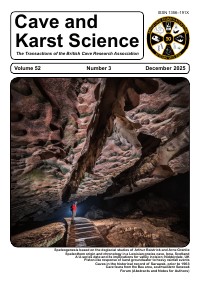
Judith Calford on part of the Boardwalk in Niah Cave, a site mentioned repeatedly in a Paper by Martin Laverty in this Issue, wherein he discusses the early (pre-Malaysia) history of cave and karst exploration in southwestern Sarawak. Deep solutional pocketing of the cave ceiling, prominent in the photograph, is suggestive of a phreatic origin for the cave, but – alternatively – might reflect a secondary overprint related to dissolution induced by the nitrification of biogenic ammonia derived from the microbial decay of bird and bat guano. (Photo: Chris Howes).
-
- Notes for contributors (page ii)
(PDF 708KB)

-
- Contents (p93)
(PDF 903KB)
-
- Editorial (p94)
(PDF 696KB)
- by John GUNN and David LOWE.
-
- Karst groundwater exhibits piston-like response to heavy rainfall during winter Storm Franklin in 2022 (Derbyshire, UK) (pp95-100)
(PDF 4.5MB)
- by Mike ROGERSON, Vasile ERSEK and Jo WHITE.
The hydrology of karst regions which have experienced mining is complex, and the impact of drainage from mines and mine waste can have a strong negative impact on water quality within springs and rivers. This can be diffuse and affect water quality under base flow conditions, but acute events can also occur when highly mineralised groundwater is displaced by high rainfall events. This study reports changes in the chemistry of a karstic conduit during an extreme rainfall event in 2022. The site, Goodluck Mine in Derbyshire (UK), has a long mining history and abundant mine waste underground and on the surface. Water which has equilibrated with this waste could be displaced into the Derwent–Trent river system, and affect water quality downstream. We report a strong displacement of water during a named storm in February 2022, which created a pronounced piston effect where older groundwater was displaced by infiltrating rainwater.
The older water has a higher temperature and conductivity than the baseflow water, and so originated from a perched water body in the unsaturated zone. However, whereas acid mine drainage would result in this water having lower pH than the baseflow water, we find that similar events later in the year had higher than baseline pH. Consequently, we conclude that the water displaced had mineralized in contact with country rock, not with mine waste deposits. The approach used here can straightforwardly be transferred to other mined karst regions to identify local histories of piston-flow water.
Classification: Paper.
- Bibliograph: ROGERSON, Mike; Vasile ERSEK and Jo WHITE. (2025). Karst groundwater exhibits piston-like response to heavy rainfall during winter Storm Franklin in 2022 (Derbyshire, UK). Cave and Karst Science 52(3), (pp95-100).
-
- Caves in the historical record of Sarawak, prior to the formation of Malaysia in 1963 (pp101-112)
(PDF 8.2MB)
- by Martin LAVERTY.
This paper presents a comprehensive miscellany of, inherently non-native, accounts of visits to caves in the Malaysian State of Sarawak, derived from many books, journals, and archives, expanding upon the work of G E Wilford. The first known cave survey from the State is reproduced, along with a selection of early drawings and photographs.
A biographical appendix follows the References to describe, briefly, the often interesting, sometimes distinguished, lives of the European cave visitors, amongst whom W M Crocker can now be identified as the first person to write about the Great Cave of Niah.
Classification: Paper.
- Bibliograph: LAVERTY, Martin. (2025). Caves in the historical record of Sarawak, prior to the formation of Malaysia in 1963. Cave and Karst Science 52(3), (pp101-112).
-
- Speleogenesis based on the deglacial studies of Arthur Raistrick in the Yorkshire Dales and Arne Grønlie in Norway (pp113-118)
(PDF 6.8MB)
- by Trevor FAULKNER.
Arthur Raistrick produced his PhD Thesis in 1925, based on study of the glaciation of the cavernous Yorkshire Dales in England, and published 16 further works on topics linked to the glaciation of the wider area. During deglaciation, the formations of ice-dammed lakes above glaciers and moraine-dammed lakes below glaciers were revealed from their overflow channels and their residual clay and silt deposits. Fifty years after the Raistrick PhD, Arne Grønlie discussed the Quaternary history of the cavernous Vefsn area in southern Nordland, Norway, and showed how ice-dammed lakes were formed there during deglaciation.
Neither author, whose insights and teachings have been largely overlooked for too long, discussed the dissolutional and depositional effects that water from glacial lakes could have on underlying karstified fractures and caves. However, later research demonstrates their importance for the speleogenesis of thousands of caves in Carboniferous sedimentary limestones in Yorkshire and in Palaeozoic Caledonide meta-limestones in central Scandinavia. Indeed, as there is no convincing alternative explanation for the development of, and sedimentation in, many of these caves, their existence supports the theory of ice-dammed lake establishment during deglaciation. Belatedly, this relationship is now being recognized from surface evidence in Britain and Sweden. This paper summarizes the evolution of deglacial ice-dammed lakes in the two regions and their roles in speleogenesis. The present deglaciation in Greenland (which is geologically, glaciologically and topographically the mirror-image of late Weichselian Scandinavia) by anthropogenic global warming might well reveal, enlarge and create karst caves at sites that are presently hidden beneath an ice sheet.
Modelling the Greenlandic deglaciation is in its infancy, with deglacial hydrology only now starting to be considered. It is therefore clear that the formation and growth of ice-dammed lakes around nunataks and mountain ridges as the ice surface downwastes will increase melt rates dramatically. Consequently, this extra contribution to the oceanic volume means that the rate of future eustatic sea-level rise will be faster than is indicated by most recent predictions.
Classification: Paper.
- Bibliograph: FAULKNER, Trevor. (2025). Speleogenesis based on the deglacial studies of Arthur Raistrick in the Yorkshire Dales and Arne Grønlie in Norway. Cave and Karst Science 52(3), (pp113-118).
-
- A U-series date from Canal Cave, Nidderdale, North Yorkshire, UK and its implications for valley incision (pp119-121)
(PDF 3.9MB)
- by Phillip J MURPHY, Kang XIE and Chris FOX.
The Canal Cave system has been drained as a result of valley incision by the River Nidd. A U-series date obtained from a speleothem sample in Canal Cave shows that cave development occurred prior to the end-Pleistocene. The presence of detrital thorium in the speleothem samples, probably reflecting the nature of rock types and their history within the catchment, limits dating precision. Interpretation of the results from this study confirms that the cave was drained shortly after the area was deglaciated.
Classification: Report.
- Bibliograph: MURPHY, Phillip J; Kang XIE and Chris FOX. (2025). A U-series date from Canal Cave, Nidderdale, North Yorkshire, UK and its implications for valley incision. Cave and Karst Science 52(3), (pp119-121).
-
- Caves and karst of SW Sarawak, Malaysia – biology; cave fauna collected in the Bau area, 1980 (pp122-124)
(PDF 1.4MB)
- by Philip CHAPMAN.
Prior to the major "British–Malaysian Speleological Expedition to Sarawak" in 1980 (the Mulu 80 Expedition), a shorter expedition to caves in the Bau area of southwestern Sarawak included some collecting of biological specimens. The provisionally identified specimens were distributed internationally for expert identification, as reported here for the first time.
Classification: Report.
- Bibliograph: CHAPMAN, Philip. (2025). Caves and karst of SW Sarawak, Malaysia – biology; cave fauna collected in the Bau area, 1980. Cave and Karst Science 52(3), (pp122-124).
-
- Origin and chronology of speleothems in a Lewisian gneiss cave on the western coast of Scotland (pp125-130)
(PDF 6.1MB)
- by Kang XIE, Martin LEE, Cristina PERSANO and John FAITHFULL.
Speleothems were recently discovered in a 40m-long coastal cave carved into silicate metamorphic rocks on the island of Iona, the Inner Hebrides, Scotland. Worldwide, calcite speleothems are found commonly in caves formed in carbonate rocks and have been used extensively as a source of data to reconstruct details of past climatic conditions. Such reconstructions have, however, been rare in Scotland, because exposure of carbonate rocks that typically host speleothem-bearing caves is limited.
Discovery of speleothems on Iona thus holds great significance, because it offers a climate proxy that, potentially, can be dated accurately. The Iona cave, which lies along the intersection of two faults within gneiss of the Lewisian Complex, hosts stalactites on its ceiling, and abundant wall flowstone from its mid-section to its far end. Whereas the origin of calcium for speleothem formation remains unclear, it is probably sourced from the dissolution of shell sands, known locally as machair. It is suggested here that this machair was deposited above the cave, by wind action, under paraglacial conditions, and then dissolved in meteoric water passing through acidic peat overlying the gneiss. This hypothesis is supported by the fact that, whereas no shell fragments are present in a peat core sampled above the cave, its section contains sand-rich layers and a calcium carbonate content (2–12% by weight) that does not match the mineralogy of the exposed bedrock. U–Th-series ages obtained from an Iona speleothem sample are affected by the presence of unconstrained, non-authigenic thorium and therefore carry significant uncertainties. It began to grow at 4.78±2.25 ka BP (before present; present = 1950 CE), a date that might represent when the cave's roof was raised above sea level in response to postglacial isostatic rebound. Study findings demonstrate that calcium carbonate speleothems can form in silicate rock settings and highlight their potential value as a new archive of Holocene environmental change for western Scotland, and other areas.
Classification: Paper.
- Bibliograph: XIE, Kang; Martin LEE, Cristina PERSANO and John FAITHFULL. (2025). Origin and chronology of speleothems in a Lewisian gneiss cave on the western coast of Scotland. Cave and Karst Science 52(3), (pp125-130).
-
- 36th BCRA Annual Cave Science Symposium 2025: Abstracts of Presentations and Posters (pp131-138)
(PDF 9.3MB)
- by Various AUTHORS.
Classification: Forum.
-
- Entering a Plea of "Sanity" (p139)
(PDF 297KB)
- by David LOWE and John GUNN.
The authors make a plea for doctoral candidates to submit an abstract of their thesis for publication in Cave and Carst Science.
Classification: Forum.
-
- Doctoral Thesis Abstract: Biofilms, including Snottites, from Caves and Mines in Northern England (p139) For download see previous item
- by Joanne WHITE.
Classification: Forum.
-
- Notes for Authors: A reviewer complains (p140)
(PDF 295KB)
- by Stephen K DONOVAN.
I recently reviewed a paper, and identified a series of simple errors that all authors should recognise and avoid. Key words are additional to the title, not just repetition. The word 'very' is an overused modifier; do not use it. A single sentence is not a paragraph. All the references in the text must appear in the reference list; all the those in the reference list must appear in the text.
Classification: Forum.
-
- Research Funds and Grants (page iii)
(PDF 624KB)
-
- Back Cover Photos (page iv)
(PDF 2.0MB)
- by Chris HOWES.
A collage of six images by Chris Howes illustrating examples of the prolific, diverse and fascinating fauna observed within the caves of Sarawak.
-

| Please ignore this information box: we are doing some maintenance
work today.
remote: Array
(
)
local:
|
|

View Contents:
BCRA is a UK registered charity and is a constituent body of
the British Caving Association,
undertaking charitable activities on behalf of the BCA.
BCRA publishes a range of periodicals and books.
Click here for further information.
|
Searching
To Search our pages using Google, type a search
string in the box at the top of the page and hit your Return key
You can also search our publications catalogue at the British Caving Library
The CREG Journal Search Engine is a new, powerful search engine which will, sometime, be extended
to cover Cave & Karst Science. We have a keyword search facility on our Cave Science Indexes pages but this may be rather out-of-date.
|
For staff use: Link to Database
Show/Hide
download figures next to each item (if available and non-zero; you might need to refresh page first). Counters last
reset on Thu 03-Jan-2019 17:29:28 +00:00. The figures are non-unique
click-throughs.
|


