- The most recent issue to be published was 135
- For further information, please see Publishing/Despatch Schedule
- Database last updated on Tue, 01 Sep 2026 12:11:49 +0100
- Online access is currently available for all issues. Some of
the older issues are bit-map scans rather than digital copies.
journal scans.
- Online voting for CREG articles was withdrawn in June 2022. For info see
Voting for CREG articles
Contents of journal 135
September 2026
This page may take a few
seconds to load. Please wait ...
- CREG Journal 135 (0-24)
(PDF 15.7MB)
  Individual articles may be available below Individual articles may be available below
- This issue has a cover date of September 2026 and was published on 1 September 2026.
-
- Summary of Contents
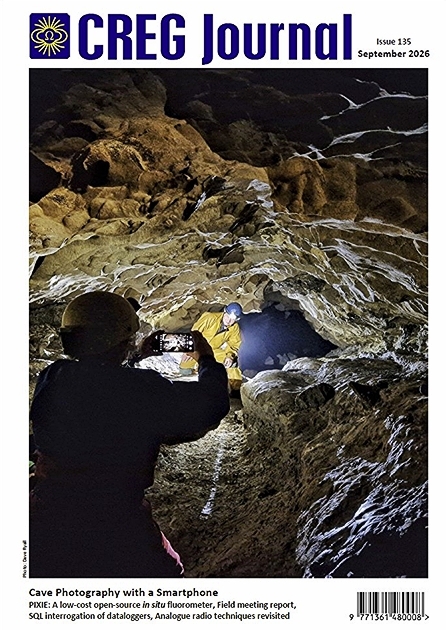
- This issue includes articles on photography, surveying, data-logging, and more. The headline article is a beginner's guide to cave photography using a smartphone. For surveyors, there is a follow-up to the article in the last issue on the open-source project for a shoulder-mounted lidar mapping system. An open-source real-time cave datalogger with telemetry is described, with details on how the data is processed using SQL queries to run statistics to understand data reliability and trends such as daily average, linear regression and correlation coefficients. An open-source submersible fluorometer is described for carrying out hydrographical flow-path mapping and analysis. Cave radio is not forgotten, with a look back at some interference cancellation techniques from the last century. The journal also takes a look back at John Rabson, who died recently and who was former editor and long-time contributor to the CREG Journal. See cover picture
 . .
See BCRA Seminars for info about CREG's series of online seminars for summer 2026. -
- Front Cover (1)
(PDF 1.2MB)
- Carol Lawrence taking photos with a smartphone in Gaping Gill, Yorkshire. Photo: Dave Ryall
-
- Contents (2)
(PDF 1.3MB)

- List of contents and masthead information.
-
- News and Notes (2) For download see previous item
- Style Guide and Submissions Guidelines, CREG Field Meeting, Hidden Earth 2026, Editorial Team.
-
- CREG Field Meeting: Spring 2026, Derbyshire (3-4)
(PDF 1.5MB)
- CREG held its recent field meeting in Castleton in the Peak District national park. Mike Bedford reports on the demonstrations and presentations.
-
- Wearable Mobile Mapping System for Cave Surveying - Part 2 (5-7)
(PDF 2.3MB)
- Previously, Janusz Bȩdkowski, Michał Pełka and Tomasz Pawłowski introduced the MANDEYE-MR - a lidar-based wearable mobile mapping system for cave surveying composed of two rigidly assembled 3D lidars. Here, they illustrate the benefits offered by this device by presenting the results of a surveying exercise in a Polish cave.
-
- Real-time Data Analysis from Cave Sensors - Part 1 (8-12)
(PDF 1.9MB)
- Luca Tringali, Alexander Debenjak, Tecla Tripari, Caterina Bearzotti and Giacomo Canciani, of Gruppo Speleologico Talpe del Carso - J.K. Kraški Krti, describe the data storage and analysis tools that have been adopted for their open-source real-time cave dataloggers with telemetry. An SQLite database is used to store data, and SQL queries are used to run different statistics to understand data reliability and trends: daily average, linear regression and correlation coefficients. The procedures and queries described here are generic enough to be easily adapted to any other data source.
-
- PIXIE: A Low-cost Open-source In-situ Fluorometer - Part 1 (13-16)
(PDF 1.6MB)
- David Eason introduces the open-source PIXIE project; a lower-cost open-source in situ submersible fluorometer. PIXIE provides four independent channels to detect multiple fluorescing agents in water flow paths near-simultaneously. Such an instrument provides a semi-professional tool for carrying out hydrographical, high-resolution flow-path mapping and analysis.
-
- Interference Cancellation - Some Analogue Techniques from the Last Century (17-19)
(PDF 2.6MB)
- Although we might be expected to desire to use digital signal processing in any new radio design, there might still be something to learn by studying older analogue processing techniques developed in the 1970s and 1980s. A number of these were described in the magazine Wireless World and the original articles are still available online. David Gibson reviews some of the techniques, one of which is distinctly novel.
-
- Interference Cancellation – Online References (webpage)
- The Wireless World articles referred to in the above article are available online.
-
- John Rabson (20)
(PDF 1.5MB)
- Former editor and long-time contributor to the CREG Journal, John Rabson died recently. Rob Gill looks back at some aspects of John's life.
-
- Mobile Phones for Underground Photography (21-24)
(PDF 1.9MB)
- Several serious cave photographers remain committed to dedicated cameras, most probably a DSLR. But, as Dave Ryall reveals, dramatic results can be obtained using a smartphone. Here, he provides a beginner's guide to smartphone cave photography.
-

|
View Contents:
BCRA is a UK registered charity and is a constituent body of
the British Caving Association,
undertaking charitable activities on behalf of the BCA.
BCRA publishes a range of periodicals and books.
Click here for further information.
|
Searching
To Search our pages using Google, type a search
string in the box at the top of the page and hit your Return key
You can also search our publications catalogue at the British Caving Library
The CREG Journal Search Engine is a new, powerful search engine which will, sometime, be extended
to cover Cave & Karst Science. We have a keyword search facility on our Cave Science Indexes pages but this may be rather out-of-date.
|
For staff use: Link to Database
Show/Hide
download figures next to each item (if available and non-zero; you might need to refresh page first). Counters last
reset on Thu 03-Jan-2019 17:29:28 +00:00. The figures are non-unique
click-throughs.
|