- The most recent issue to be published was 51(2)
- For further information, please see Publishing/Despatch Schedule
- Database last updated on Tue, 01 Oct 2024 18:25:12 +0100
Open Access to C&KS: From Volume 51(1) (April 2024) all individual papers in C&KS will be Open Access, although some additional content
(e.g. supplements) might still require a login. Open Access means that you will not need to log in to download a paper. Open Access is indicated by the open padlock icon
next to each listing. Issues of C&KS published before 2024
(i.e. volume 50 and earlier) continue to require a login, which is free. BCRA members may apply for a free online id, and all visitors to these pages are offered
the option of a monthly free login when they try to download any protected content.
Contents of Cave & Karst Science 36(2)
This page may take a few seconds
to load. Please wait ...
- Cave and Karst Science (iv + 32pp)
(PDF 36.4MB)
  Individual articles may be available below Individual articles may be available below
- GUNN, John and David LOWE (eds.). (2009). Cave and Karst Science
36(2).
Buxton: British Cave Research Association.
ISSN 1356-191X. iv + 32pp, A4, with photos, maps and diagrams.
This issue has a cover date of 2009 (August) and was published in May 2010.
- The Transactions of the British Cave Research Association
- Layman's Summaries
-
Some of the articles in this issue are explained in a layman's summary.
Look for the 'Summary' icons below, or download the article from here:
PDF 479KB
 
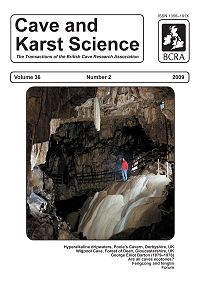
- Front cover photo (page i)
(PDF 6.1MB)
- by Paul DEAKIN.
The upstream end of the 130m-long main chamber of Poole's Cavern, in the Derbyshire Peak District, UK, highlighting the 2m-long Flitch of Bacon stalactite, so-called because early visitors, whose only illumination was candlelight, thought it resembled half a pig - a flitch - hanging in a butcher's shop. The stalactite's tip was broken off during the 19th century by rocks thrown by vandals. This stalactite, and the fine gour terraces, were formed by the 'normal' process of calcite deposition by de-gassing of CO2, unlike the speleothems described by Hartland et al. in this Issue. (Original photograph by Paul Deakin, FRPS).
-
- Notes for Contributors (page ii)
(PDF 628KB)
-
- Contents (p33)
(PDF 655KB)
-
- Notice of BCRA Field Meeting 8 Sept 2010 (p34)
(PDF 634KB)
-
- Editorial (p35)
(PDF 567KB)
- by John GUNN and David LOWE.
-
- Roger Jacobi, obituary (p36)
(PDF 605KB)
- by Andy CURRANT.
-
- The dripwaters and speleothems of Poole's Cavern: a review of recent and ongoing research (pp37-46)
(PDF 9.3MB)
- by Adam HARTLAND, Ian J FAIRCHILD, Jamie R LEAD, David DOMINGUEZ-VILLAR, Andy BAKER, John GUNN, Mohammed BAALOUSHA and Yon JU-NAM.
This paper describes aspects of the geochemical conditions prevalent in the dripwaters of Poole's Cavern, Buxton, UK. We examine what makes Poole's Cavern both highly unusual, and also, extremely useful for understanding geochemical processes, both in hyperalkaline, and natural karstic systems. We review the findings of ongoing research into the colloidal and dissolved organic species and associated trace elements in hyperalkaline dripwaters and show that the composition and appearance of poached-egg stalagmites can largely be explained by the high pH conditions prevalent in their parent waters and the carbon dioxide sources in cave air.
Summary: For layman's summary see
PDF 479KB
Classification: Paper.
Date: Received 4 March 2010; Accepted 05 April 2010.
Keywords: hyperalkaline, speleothems, organic carbon, trace metals, colloids, CO2.
- Bibliograph: HARTLAND, Adam; Ian J FAIRCHILD, Jamie R LEAD, David DOMINGUEZ-VILLAR, Andy BAKER, John GUNN, Mohammed BAALOUSHA and Yon JU-NAM. (2009). The dripwaters and speleothems of Poole's Cavern: a review of recent and ongoing research. Cave and Karst Science 36(2), pp37-46.
-
- George Elliot Barton (1898-1978): talented explorer of Stump Cross Caverns - and beyond - in the 1920s (pp47-48)
(PDF 2.4MB)
- by Stephen A CRAVEN.
Summary: For layman's summary see
PDF 479KB
Classification: Report.
Date: Received 28 October 2009; Accepted 30 January 2010.
- Bibliograph: CRAVEN, Stephen A. (2009). George Elliot Barton (1898-1978): talented explorer of Stump Cross Caverns - and beyond - in the 1920s. Cave and Karst Science 36(2), pp47-48.
-
- Reflections on fengcong and fenglin (pp49-51)
(PDF 2.0MB)
- by Mick DAY and Wei HUANG.
Comment on Waltham, T. Fengcong, fenglin, cone karst and tower karst. Cave and Karst Science, Vol.35(3), pp.77-88.
Summary: For layman's summary see
PDF 479KB
Classification: Report.
Date: Received 28 February 2010; Accepted 03 March 2010.
- Bibliograph: DAY, Mick and Wei HUANG. (2009). Reflections on fengcong and fenglin. Cave and Karst Science 36(2), pp49-51.
-
- Reflections on fengcong and fenglin (p52)
(PDF 3.7MB)
- by Tony WALTHAM.
Response to the Comment by Day and Huang: Cave and Karst Science, Volume 36, Number 2, pp.49-51.
Classification: Report.
Date: Received 04 April 2010; Accepted 06 April 2010.
- Bibliograph: WALTHAM, Tony. (2009). Reflections on fengcong and fenglin. Cave and Karst Science 36(2), p52.
-
- Are all caves ecotones (pp53-58)
(PDF 2.6MB)
- by Max MOSELEY.
It is proposed that the ecological concept of an ecotone (a zone of steep environmental gradient between adjacent ecological communities or ecosystems) could be applied to caves in their entirety. Arguments are given in support of this proposal, and some of the conceptual, theoretical and empirical implications are highlighted and briefly discussed.
Summary: For layman's summary see
PDF 479KB
Classification: Paper.
Keywords: caves, zonation, ecotones, communities.
- Bibliograph: MOSELEY, Max. (2009). Are all caves ecotones. Cave and Karst Science 36(2), pp53-58.
-
- An interim Report on Wigpool Cave: a syncline-guided, palaeo drainage cave in the Forest of Dean limestone basin, UK (pp59-62)
(PDF 2.0MB)
- by Chris BOWEN.
In the past the Forest of Dean limestone basin has been subjected to intensive cave forming processes and deposition of iron minerals. A network of caverns, infilled with generally high-grade iron ore, was formed in early Carboniferous limestone beds now exposed around the rim of the basin. Today the known ore caverns are empty following many years of mining, and they are visited by cave explorers and cave scientists. Recent explorations in the Wigpool Iron-ore Mine have led to the discovery of the Wigpool Cave, a well-developed, multi-level, cave system that evolved along the southward-plunging axis of the Wigpool Syncline - the northeastern culmination of the Forest of Dean Basin - and which drained an ancient landscape from the surface down to the contemporary water table.
Summary: For layman's summary see
PDF 479KB
Classification: Report.
Date: Received 24 February 2010; Accepted 06 April 2010.
- Bibliograph: BOWEN, Chris. (2009). An interim Report on Wigpool Cave: a syncline-guided, palaeo drainage cave in the Forest of Dean limestone basin, UK. Cave and Karst Science 36(2), pp59-62.
-
- Book Reviews (pp63-64)
(PDF 2.2MB)
- 1) Culver, D C and Pipan, T. 2009. The biology of caves and other subterranean habitats. Oxford University Press. Biology of habitats series. xviii + 254 pp. £60 hardback (ISBN-13: 9780199219926), £29.95; softback (ISBN-13: 9780199219933).
2) Romero, A. 2009. Cave biology. Life in darkness. Cambridge University Press. Ecology, biodiversity and conservation series. xiv + 291 pp. £75 hardback (ISBN-13: 9780521828468), £34.99; softback (ISBN-13: 9780521535533).
3) Karstologia 53 (2009).
Classification: Forum.
-
- World Karst Science (p64)
(PDF 2.1MB)
- Karstologia 53 (2009).
Classification: Forum.
-
- Research Fund and Grants (page iii)
(PDF 617KB)
-
- Back cover photos (page iv)
(PDF 10.3MB)
- by Paul DEAKIN and John GUNN.
A montage of images illustrating various aspects of hyperalkaline calcite deposition and deposits at sites in the area around Buxton in the Derbyshire Peak District, United Kingdom. (images 1 to 3 are derived from original photographs by Paul Deakin, FRPS; images 4 to 8 are from originals by John Gunn. For a description of each, please refer to the contents page of this issue).
-

| Please ignore this information box: we are doing some maintenance
work today.
remote: Array
(
)
local:
|
|

View Contents:
BCRA is a UK registered charity and is a constituent body of
the British Caving Association,
undertaking charitable activities on behalf of the BCA.
BCRA publishes a range of periodicals and books.
Click here for further information.
|
Searching
To Search our pages using Google, type a search
string in the box at the top of the page and hit your Return key
You can also search our publications catalogue at the British Caving Library
The CREG Journal Search Engine is a new, powerful search engine which will, sometime, be extended
to cover Cave & Karst Science. We have a keyword search facility on our Cave Science Indexes pages but this may be rather out-of-date.
|
For staff use: Link to Database
Show/Hide
download figures next to each item (if available and non-zero; you might need to refresh page first). Counters last
reset on Thu 03-Jan-2019 17:29:28 +00:00. The figures are non-unique
click-throughs.
|


