- The most recent issue to be published was 50(3)
- For further information, please see Publishing/Despatch Schedule
- Database last updated on Sun, 18 Feb 2024 09:37:35 +0000
Contents of Cave & Karst Science 34(1)
This page may take a few seconds
to load. Please wait ...
- Cave and Karst Science (iv + 48pp)
(PDF 6.3MB)
  Individual articles may be available below Individual articles may be available below
- GUNN, John and David LOWE (eds.). (2007). Cave and Karst Science
34(1).
Buxton: British Cave Research Association.
ISSN 1356-191X. iv + 48pp, A4, with photos, maps and diagrams.
This issue has a cover date of 2007 (April) and was published in August 2008.
- The Transactions of the British Cave Research Association
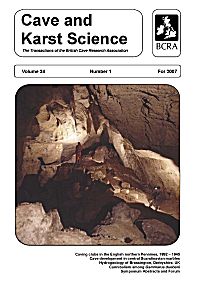
- Front cover photo (page i)
(PDF 200KB)
- by Paul DEAKIN.
The "Big Shack" in Golconda Mine, Brassington, Derbyshire (see paper by Ford and Gunn in this Issue).
Peak District lead miners applied the term 'shack' to isolated caverns that they encountered. The Big Shack is a fine example, being 100m long and 20m wide and high. It lies close to the base of dolomitized Dinantian limestones (that also crop out on the surface), just above their boundary with underlying less porous limestone. This is also a preferred location for mineralization (flats) and might mark an ancient inception horizon. Much of the cavern development is thought to have taken place in the late Pliocene, largely by dissolution in the phreatic zone when the water table was much higher than at present. The Big Shack and similar caverns in this area had already been drained when first encountered by the lead miners, and their workings of flats beneath the shacks caused partial collapse, so that the present morphology is dominated by joint-block failures. Photo by Paul Deakin, FRPS.
-
- Advert for the Encyclopedia of Caves and Karst Science (pp ii-iii)
(PDF 899KB)

-
- Contents (p1)
(PDF 158KB)
-
- Editorial (p2)
(PDF 142KB)
- by David LOWE and John GUNN.
-
- The top-down, middle-outwards model of cave development in central Scandinavian marbles (pp3-16)
(PDF 1.5MB)
- by Trevor FAULKNER.
The epigean marble caves in the glaciated metamorphic Caledonides of central Scandinavia provide a rare environment in which endokarstic morphologies and other internal cave attributes have been studied against variations in foliation dip and topographical characteristics, to produce a common static internal model of cave existence. This paper proposes a dynamic model to explain the sequential developments of cave passage elements from inception fractures that are created seismically during isostatic uplift. The speleogenesis is driven by Cenozoic glacial cycles consisting of periods of glaciation, deglaciation and interglaciation. The more complex caves have evolved top-downwards in deglacial phreatic conditions under ice-dammed lakes and subsequently along their lowest levels in interglacial vadose conditions, with later extensions upstream and downstream. Glacial erosion also removes passages in a topdown order, but with passage extremities being eroded away inwards.
Classification: Paper.
Date: Received 21 February 07; accepted 12 September 07.
Keywords: Caledonide, deglaciation, foliation, marble, monoclinal, morphology, Top-down, middleoutwards.
- Bibliograph: FAULKNER, Trevor. (2007). The top-down, middle-outwards model of cave development in central Scandinavian marbles. Cave and Karst Science 34(1), pp3-16.
-
- Hydrogeology of the Brassington area, Derbyshire, UK (pp17-22)
(PDF 372KB)
- by Trevor D FORD and John GUNN.
The subterranean drainage of the partly dolomitized Carboniferous Limestone of Brassington Moor is deduced to be mainly via mineral vein fissures in both limestones and dolomites. Some of the drainage remains close to the water table and resurges without any rise of temperature, whereas other drainage circulates at depth and returns as thermal springs. Before the late 18th century drainage probably resurged at springs in the Via Gellia but these are largely inoperative having been dewatered by man-made lead mine drainage levels (soughs). Although a limited flow still comes from Cromford Sough, this in turn has been largely dewatered by the lower Meerbrook Sough, which discharges a mix of both cold and thermal waters.
Classification: Paper.
Date: Received 04 March 2007; Accepted 02 April 2008.
- Bibliograph: FORD, Trevor D and John GUNN. (2007). Hydrogeology of the Brassington area, Derbyshire, UK. Cave and Karst Science 34(1), pp17-22.
-
- History of cave exploration in the Northern Pennines of England: the work of the clubs, 1892 – 1945 (pp23-32)
(PDF 2.9MB)
- by Stephen A CRAVEN.
The paper records the trends of cave exploration in the English Northern Pennines between 1892 and 1945. With the exception of Stump Cross Cavern, White Scar Cave and Lost John’s Hole, all the major discoveries were made by members of the organized caving clubs.
Classification: Paper.
Date: Received 26 November 2007; Accepted 28 January 2008.
- Bibliograph: CRAVEN, Stephen A. (2007). History of cave exploration in the Northern Pennines of England: the work of the clubs, 1892 – 1945. Cave and Karst Science 34(1), pp23-32.
-
- Cannibalism within freshwater shrimp populations (Gammarus duebeni - Crustacea: Amphipoda) from spring, riverine and subterranean habitats, Marble Arch Cave System (Northern Ireland) (pp33-36)
(PDF 245KB)
- by Thomas P WORRALL and Paul J WOOD.
The paper examines cannibalism within Gammarus duebeni (Crustacea: Amphipoda) populations within surface stream, spring and cave habitats. The level of cannibalism was measured via bioassay enclosure experiments in the vicinity of the Marble Arch Cave system. The occurrence of cannibalism was found to be significantly greater within cave populations, compared to epigean spring and riverine populations. The relative length of an individual in relation to its mass (Body Mass Index) was significantly greater for riverine populations when compared to both caves and springs.
Classification: Paper.
Keywords: Intra-specific predation, freshwater shrimp, spring, riverine, subterranean.
- Bibliograph: WORRALL, Thomas P and Paul J WOOD. (2007). Cannibalism within freshwater shrimp populations (Gammarus duebeni - Crustacea: Amphipoda) from spring, riverine and subterranean habitats, Marble Arch Cave System (Northern Ireland). Cave and Karst Science 34(1), pp33-36.
-
- Abstracts Of the 19th BCRA Cave Science Symposium, Loughborough University, 8 March 2008 (pp37-41)
(PDF 353KB)
- Classification: Forum.
-
- Book Reviews (pp41-45)
(PDF 475KB)
- 1) Karst Hydrogeology and Geomorphology by Derek Ford and Paul Williams. John Wiley and Sons Ltd, 2007, 562pp. ISBN 978-0-470-84996-5 [HB]; ISBN 978-0-470-84997-2 [PB]. List price £90.00 (EUR 126.00) [hardcover] or £34.95 (EUR 49.00).
2) The Yorkshire Dales: LANDSCAPE AND GEOLOGY. By Tony Waltham. Published by The Crowood Press Ltd, Ramsbury, Marlborough, Wiltshire, SN8 2HR. 224pp, 226 colour photos, 45 maps and diagrams. Soft back. ISBN 978-1-86126-972-0. £16.99.
3) Natural and Anthropogenic Hazards in Karst Areas: Recognition, Analysis and Mitigation, edited by M Parise and J Gunn. Geological Society Special Publication No.279, 202pp. 2007. ISBN 978-1-86239-224-3. Price £70. Geological Society of London members £35. Available from the Geological Society Publishing House, Unit 7, Brassmill Enterprise Centre, Bath, BA1 3JN, UK.
4) Karstologia 2007/50.
Classification: Forum.
-
- Other Recent Karst Publications (pp45-46)
(PDF 286KB)
- Classification: Forum.
-
- Notes for contributors (p47)
(PDF 186KB)
-
- Research Fund and Grants (p48)
(PDF 160KB)
-
- Back cover photos (page iv)
(PDF 1.3MB)
- by Jerry WOOLDRIDGE.
[Top left] Carrot-like development on a straw stalactite. Formerly near the Trident and the Judge in Ogof Ffynnon Ddu II, this unusual speleothem has long since disappeared.
[Top right] Unusual stalagmite development in Beimo Dong - Guangxi, China. The surface texture is thought to relate to a daily reversal of the cave's draught.
[Bottom left] A helictite in Pendulum Passage, Ogof Ffynnon Ddu II.
[Bottom right] The Pom Pom in Ogof Ffynnon Ddu II. Crystal growth has occurred around the bottom of a straw stalactite in a pool.
All images by Jerry Wooldridge FRPS.
-

| Please ignore this information box: we are doing some maintenance
work today.
remote: Array
(
)
local:
|
|

View Contents:
BCRA is a UK registered charity and is a constituent body of
the British Caving Association,
undertaking charitable activities on behalf of the BCA.
BCRA publishes a range of periodicals and books.
Click here for further information.
|
Searching
To Search our pages using Google, type a search
string in the box at the top of the page and hit your Return key
You can also search our publications catalogue at the British Caving Library
The CREG Journal Search Engine is a new, powerful search engine which will, sometime, be extended
to cover Cave & Karst Science. We have a keyword search facility on our Cave Science Indexes pages but this may be rather out-of-date.
|
For staff use: Link to Database
Show/Hide
download figures next to each item (if available and non-zero; you might need to refresh page first). Counters last
reset on Thu 03-Jan-2019 17:29:28 +00:00. The figures are non-unique
click-throughs.
|


